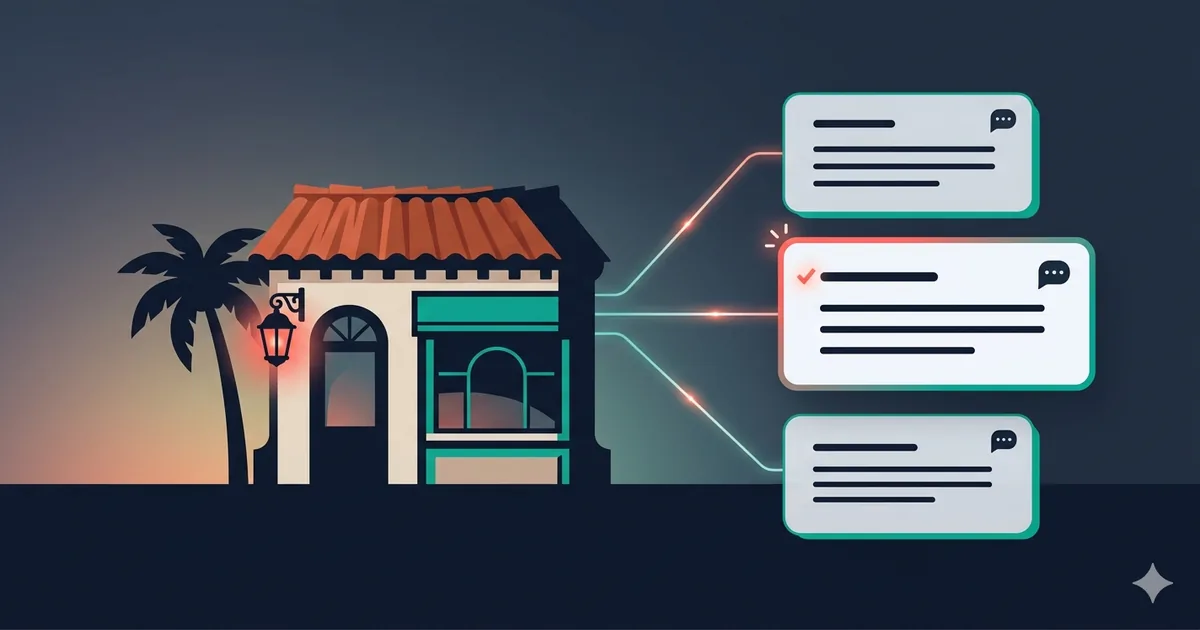
For St. Augustine small businesses, AI search means your next customer may never see a Google results page at all - they’ll get a five-business recommendation from ChatGPT, Perplexity, or Google AI Overviews instead. The businesses that show up in those answers in 2026 will own the next decade of local visibility. Most local agencies in Northeast Florida are still pretending none of this is happening.
The shift isn’t hypothetical. Run “best plumber in St. Augustine for a slab leak” through ChatGPT and you’ll get a confident, named answer - three to five businesses with reasons. Some aren’t even ranking in Google’s top 20. AI uses its own data sources, weights them its own way, and customers are trusting the answer.
The position of this post: ignoring AI search in 2026 is the same mistake businesses made ignoring Featured Snippets in 2018. Once a search surface stops returning ten links and starts returning one synthesized answer, answer-first content optimization stops being optional. The 90-day plan at the end gives you a concrete place to start.
What is AI search, in plain English?
AI search is when a person types a question into an AI assistant - ChatGPT, Perplexity, Google AI Overviews, Microsoft Copilot - and gets a direct answer instead of a list of blue links. The assistant reads the open web, synthesizes what it finds, and writes a single response that often names specific businesses, products, or sources. Citations appear as small footnote-style links beneath the answer.
The interface change is the whole story. On a traditional Google search you scrolled through ten results and picked one. On an AI search you read one answer that already filtered the ten down to a recommendation. If your business is in the answer, you got the lead. If it isn’t, you didn’t.
This is layered on top of regular Google search - not replacing it overnight. The local map pack still shows up. The blue links still rank. But a growing slice of search queries never makes it to a results page at all. In February 2024, Gartner predicted that traditional search engine query volume would drop 25% by 2026 as users substitute AI chatbots for some queries. The 2026 reality is more nuanced: Google’s own AI Overviews coverage peaked at roughly 25% of queries in July 2025 and pulled back to under 16% by November, and emerging behavior data suggests AI search has been mostly additive to Google use rather than a wholesale substitute - at least so far. The shift is real, but it’s an expansion of where customers find you, not a clean replacement of Google.
For a St. Augustine small business, the practical takeaway is short: you now have two visibility surfaces to optimize for - Google’s ranking algorithm and the language models writing AI answers. They overlap, but they aren’t the same surface, and the work for one only helps the other if someone is actually doing it.
How are St. Augustine customers actually asking AI for local recommendations?
Customers are asking longer, more natural questions and trusting the answer. The query patterns we see are not “St. Augustine plumber” - they’re full sentences with context. AI handles that well, and customers know it does, so they include detail they’d never type into a Google box.
Four patterns are now common for local AI queries:
Situational queries. “I think I have a slab leak under the kitchen in St. Augustine - who should I call?” AI answers with two or three named plumbers and explains why each fits. Highest-intent local AI query type, fastest-growing.
Comparison queries. “Compare the top three small-business law firms in St. Augustine for an LLC formation.” AI returns a real comparison with strengths and weaknesses. If you have no schema, no reviews, and no answer-first content, you don’t appear at all.
Pre-decision validation. “Is [business name] in St. Augustine actually any good?” The customer already heard your name and is asking AI for a second opinion before calling. A weak online presence here kills deals you never knew you had.
Itinerary and trip planning. “Best dinner in St. Augustine near the historic district that isn’t a tourist trap?” St. Augustine and St. Johns County see more than 6 million annual visitors per Florida’s Historic Coast tourism data, and a growing share plan trips with AI. Restaurants, tours, and lodging without AI-ready content are invisible to that traffic.
The behavior shift compared to traditional Google looks like this:
| Customer behavior | Old (Google SERP) | New (AI answer) |
|---|---|---|
| Query length | 2–4 keywords | 1–3 full sentences with context |
| What they get | 10 ranked links + map pack | 1 written answer naming 3–5 businesses |
| Time to decision | 2–10 minutes scrolling and comparing | 30–60 seconds reading the answer |
| Visibility floor | Page 1 of results (top 10) | Named in the answer (top 3–5) |
| Trust signal | Position on the page + reviews | AI's confidence + cited sources |
The visibility floor moved from “be in the top 10” to “be one of three to five names.” That’s a much narrower window - and it’s the entire game.
Why are local agencies still ignoring AI search?
Most local agencies are ignoring AI search because they haven’t figured out how to package it, price it, or measure it. The honest answer is structural, not technical - and it tells you something about who to work with.
Three reasons it isn’t on their menu:
Pricing built around Google ranking reports. The standard Northeast Florida local SEO retainer is a monthly deliverable: a ranking report, a few backlinks, a couple of GBP posts. There’s no clean “AI ranking report” tool yet that fits that template, so agencies don’t sell the work.
They’re telling clients it’s too early. Same line agencies used about voice search in 2017. The argument - “AI search is still single-digit traffic share, focus on Google” - ignores that the visibility you’ll have in 2027 is being decided by what you publish in 2026.
It requires three skill stacks at once. Ranking in AI answers needs good content, good structure (schema, FAQ, entity clarity), and good reputation (reviews, citations, mentions). Most local agencies are strong in one - usually citations or backlinks - and won’t invest to do all three.
The result is a gap. Every St. Augustine small business owner we talk to has heard about ChatGPT. Almost none have been asked about it by their current marketing provider. The agency that brings up AI search before you do is the agency that’s actually paying attention.
Where does AI search pull its local recommendations from?
AI search pulls from a stack of public web sources, almost all of which you can influence directly. No secret algorithm to reverse-engineer - inputs that matter fall into a handful of categories, and businesses that show up in AI answers are doing the work on most of them.
| Source | What AI extracts | How you influence it |
|---|---|---|
| Google Business Profile | Name, category, hours, services, reviews, photos, posts | Claim, optimize categories, post weekly, respond to every review |
| Your website + structured data | Services, location, FAQ answers, author E-E-A-T signals | Add LocalBusiness, Service, FAQPage schema; write answer-first content |
| Review platforms (Google, Yelp, BBB) | Star average, review count, sentiment themes, response rate | Systematic review acquisition; respond within 48 hours |
| Local citations (40+ directories) | NAP consistency, category match, mentions volume | Get listed on Tier 1 directories; keep NAP identical everywhere |
| Original content + answer-first posts | Direct answers to specific natural-language questions | Publish content that answers real customer questions, with FAQ schema |
| Forum and community mentions | Authentic local sentiment (Reddit, Nextdoor, local Facebook) | Engage authentically - never spam; encourage real customers to mention you |
| News and PR mentions | Authority signals; freshness | Local press, awards, podcast guesting, contributed articles |
| Wikipedia and entity graphs | Canonical entity grounding for proper nouns | Indirect - strong web presence eventually feeds entity graphs |
Notice what’s missing as a direct AI input: paid ad spend. AI engines don’t read your Google Ads budget or your Meta campaigns directly - but they do read the brand-search volume and behavioral signals that paid campaigns help generate, so paid and organic aren’t fully separate channels for AI visibility. AI visibility is earned through the same kind of signal-building that earned organic visibility ten years ago, done with awareness of how language models extract content. The full local SEO foundation is covered in our St. Augustine small business SEO guide.
What does the local answer surface actually look like in 2026?
The local AI search surface is more nuanced than the headlines suggest. Per Whitespark’s Q2 2025 local SERP analysis, AI Overviews appear on roughly 68% of local searches overall - but the breakdown by query type matters more than the headline number:
- Simple local queries (“plumber St. Augustine,” “HVAC near me”) show AI Overviews on only ~15% of results. The local pack still appears on more than 90% - and remains the top conversion lever for high-intent commercial queries.
- Informational local queries (“how do I find a good plumber in St. Augustine”) show AI Overviews on ~92% of results. This is where the AI surface dominates and where answer-first content wins.
- Hybrid-intent queries (“should I hire a local SEO agency in St. Augustine”) show AI Overviews on ~97% of results.
For a St. Augustine service business, the high-intent commercial queries that drive most leads are still won in the map pack. The consideration-stage queries - exactly what your blog content should target - are where AI search dominates. Both surfaces matter; the foundation work here helps both at once.
Why do St. Augustine small businesses have an AI-search advantage?
St. Augustine small businesses have a real AI-search advantage because the answer space here isn’t yet crowded. AI engines reward early movers in markets where signal quality is high and competitive volume is low - Northeast Florida is exactly that kind of market for now.
Three reasons the advantage is real:
Thin training data on Northeast Florida specifics. AI models have seen enormous content about Miami, Atlanta, and Orlando; those answer spaces are saturated. Content about St. Johns County drainage issues, hurricane prep on Anastasia Island, salt-air corrosion on coastal HVAC, or historic-district zoning is comparatively scarce - and a St. Augustine business publishing on those specifics becomes a rare authority for AI to cite.
Most competitors are still on zero. The local-pack competitive set is full of unclaimed Google Business Profiles, websites with no schema, and businesses with five reviews from 2019. Doing the basics - claim, optimize, weekly posts, real reviews, FAQ schema on service pages - puts you ahead of 80% of local competitors on AI signals.
Tourism is a massive AI use case. With more than 6 million annual visitors to the St. Augustine area, a growing share planning trips with AI assistance, restaurants, tours, B&Bs, and adjacent service businesses with AI-ready itinerary content show up in those trip-planning answers - a discovery channel competitors can’t easily copy once you’ve established it.
The window won’t last. By 2027 the local AI answer space will look more like Miami’s - crowded, contested. Right now St. Augustine is closer to where Google was in 2010: open, learnable, and rewarding to anyone willing to do the work.
What does “too early to bother with AI search” get wrong?
The “too early” argument gets the timeline wrong in two specific ways. First, it treats AI search as a future event you can wait on. Second, it ignores that the visibility you’ll have in 2027 is being decided by what you publish in 2026. Both errors cost the same thing: a year of compounding you can’t get back.
Both indexing and reputation lag real publishing by months. When ChatGPT or Perplexity recommends businesses today, they’re drawing on content indexed weeks or months ago and reviews earned even earlier. Twenty-five real Google reviews don’t appear overnight, forty consistent citations take a month of focused work, and schema improvements need to be crawled and re-crawled. The trust signal stack compounds through actual elapsed time - not through spending more money later.
The Featured Snippets parallel from 2018 is the cleanest historical analog. When Google rolled out the answer box, agencies told clients snippets were a fad and that ranking the underlying page was what mattered. The brands that ignored snippet optimization spent the next four years climbing back into them; the brands that wrote answer-first content from day one captured the box and kept it. AI citations work the same way - the answer-first writing, FAQ schema, and entity clarity that win snippets are the same signals that earn AI citations. Brands that wait won’t be sitting still; they’ll be losing ground to the brands that didn’t.
The argument against starting now is always “we’ll get to it next quarter.” Five years of next quarters is how a business becomes invisible in a search surface that didn’t exist when they last reviewed their marketing.
Will being named in an AI answer actually drive customers?
Sometimes yes, sometimes no - the math is different for local service businesses than for publishers. Seer Interactive’s September 2025 study found organic click-through rates fell 61% on queries where AI Overviews appeared (1.76% → 0.61%). Being cited doesn’t automatically equal a website visit. That’s the bear case.
For a local service business in St. Augustine, it’s less brutal than it sounds:
- Phone calls and direction taps don’t need a website click. Many local AI answers surface a name, hours, and number directly. The customer calls; you never see the click.
- Brand reinforcement compounds. A customer who sees your name in an AI answer often Googles it later for due diligence - and a branded search converts at 3–5x the rate of a generic one.
- First-place AI citation often outperforms first-place organic for high-intent local queries, because being the named recommendation closes the consideration loop faster than being one of ten options.
Track this instead of CTR: branded Google search volume, GBP “direct” call and direction taps, and your monthly AI visibility audit. Those are the AI-era equivalents of a ranking report - and they catch what CTR-only misses.
The 90-day local AI-search action plan
The 90-day plan is three 30-day phases - foundation, content, compound - and almost every step is free or low-cost. The work is doable for any St. Augustine small business willing to spend two hours a week. The order matters.
Days 1–30: Foundation
- Run an AI visibility audit. Open ChatGPT, Perplexity, and Google’s AI Overviews and search five real customer queries: “best [your service] in St. Augustine,” “top [your category] near me St. Augustine FL,” plus three problem-specific phrasings a real customer would use. Note where you appear, where you don’t, and which competitors do.
- Claim and optimize your Google Business Profile end-to-end if you haven’t. The full GBP playbook is in our Google Business Profile setup guide for St. Augustine service businesses.
- Add LocalBusiness, Service, and FAQPage schema to your website. Most modern site builders can do this; if yours can’t, that’s a sign your site is overdue for a rebuild.
- Audit and standardize your Name-Address-Phone (NAP) across the top twelve local directories. AI weighs NAP consistency heavily for local entity grounding.
Days 31–60: Content
- Publish four answer-first blog posts targeting the natural-language questions you saw in your AI audit. Each post answers one specific customer question in the first paragraph, supports it with depth, and includes a real FAQ section. This is the format AI engines lift verbatim.
- Add FAQ schema to every service page. Use the actual questions customers ask on calls - not invented ones.
- Run a focused thirty-day push to earn ten or more new Google reviews from recent real customers. Use a text-message ask within 24 hours of service completion; that one window roughly doubles response rates over a delayed email.
- Add structured data for each service you offer (Service schema with description, area served, and price range when applicable).
Days 61–90: Compound
- Publish four more answer-first posts. By day 90 you have eight pieces of indexed answer-first content - enough for AI engines to recognize a pattern of authority.
- Maintain weekly Google Business Profile posts and add five new photos a month. Both feed AI freshness signals.
- Re-run the AI visibility audit from day 1. Note the deltas - which queries surface you now? Which competitors faded? Which gaps remain?
- Track three to five long-tail local queries monthly going forward. This is your real AI ranking report until tools catch up.
One reality check: even with this plan executed perfectly, AI engines may cite an aggregator (Yelp, BBB, Angi, Tripadvisor) instead of your site directly. Yelp signed a data licensing agreement with OpenAI in early 2026; Google AI Overviews lean on Reddit and major review sites for local validation; Perplexity favors high-domain-authority sources. Claim and optimize your Yelp, BBB, Tripadvisor (for tourism-adjacent businesses), and Foursquare profiles alongside GBP - the full 40-citation list is covered in a future post in this cluster. Honest framing: this work meaningfully increases your odds of being the named recommendation, but the answer surface is probabilistic - no plan guarantees citation.
A St. Augustine small business that runs this 90-day plan typically begins surfacing in AI answers for two or three long-tail queries by day 90 and has the foundation to compound from there - a measurable head start over local competition still pretending none of this matters.
Next step: build your AI search foundation before competitors do
Most St. Augustine small businesses are starting from zero on AI search - almost everyone is. The agency that built your website three years ago hasn’t mentioned this because most haven’t figured out how to charge for it. The opening won’t stay wide forever.
We built our SEO and AI search optimization service around this gap - schema, answer-first content, GBP optimization, citation cleanup, review systems - measured against real AI visibility, not just Google ranking reports. Twenty-five-plus years of pre-AI engineering experience underneath, AI-augmented delivery on top, transparent monthly pricing, no contracts. More on how we got here.
If your visibility plan stops at Google, your visibility stops at Google. The next decade of local discovery happens in answer boxes and chat windows - and the businesses that show up there are the ones doing the work in 2026.
See our SEO and AI search optimization service →
Want the foundation underneath this? Read our complete local SEO guide for St. Augustine businesses, or jump to the GBP setup playbook for service businesses - both are prerequisites for AI search visibility.