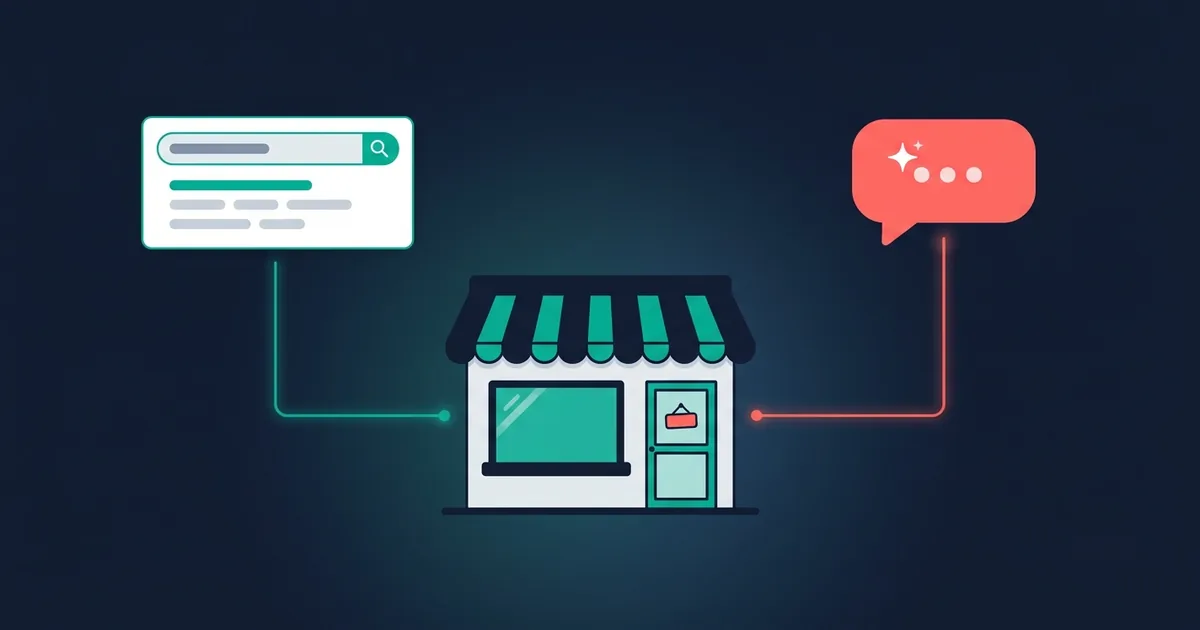
Getting found online used to mean one thing: showing up on Google. Now there are two front doors - Google and AI tools like ChatGPT and Perplexity that answer questions and recommend businesses by name. The good news for busy St. Augustine business owners: they both reward the same simple things. You don’t need to be technical to understand them, and you shouldn’t have to build them yourself.
Here’s the plain-English version of what actually makes a website easy for both to find, understand, and recommend.
One page, one job
The biggest mistake small business websites make is trying to say everything on one page. Both Google and AI reward a page that answers one question well over a page that touches five topics halfway. If you fix cars and sell tires and offer roadside help, that’s three pages - not one crowded one.
Think of each page as answering a single question a customer would actually ask. That clarity is the foundation everything else sits on.
Say the answer first
When someone (or an AI) asks a question, the answer should be in your first sentence or two - not three paragraphs down. AI tools pull the direct answer and skip the windup. If you bury the point behind a long introduction, you simply get passed over.
So lead with the answer, then add the detail. “We offer same-day AC repair in St. Augustine” beats “For over a decade, our family has been passionate about comfort…” every time.
Help the machines understand you (schema)
Schema is a small piece of behind-the-scenes code that labels your content for machines - this is a review, this is our address, this is a service, this is a FAQ. Your visitors never see it. It just removes the guesswork.
Why it matters more now: AI answer engines lean on this structured data to pull facts confidently. Schema is basically a shortcut that lowers the odds a machine gets you wrong - and raises the odds it recommends you. The one rule: it has to match what’s actually on the page. Labeling something you don’t really offer is a trust problem, and both Google and AI flag it.
The new file that speaks to AI (llms.txt)
There’s a newer piece worth knowing about: a simple text file called llms.txt that lives on your website and gives AI models a clean summary of who you are and which pages matter most. Think of it as a cheat sheet written specifically for AI.
Search engines read your whole site. AI models often can’t - so instead of making them dig through menus and ads, you hand them the highlights. It’s still early, and not every AI platform uses it yet - but forward-looking sites are adopting it now, the same way smart sites added sitemaps before every search engine required them. (Yes, this site has one.)
The basics that still quietly matter
None of the above replaces a few fundamentals. These are unglamorous, but they move the needle:
| Do this | Why it helps |
|---|---|
| Clear page titles and descriptions | Tells Google and AI what each page is about at a glance |
| Short paragraphs, headings, and bullets | Easy for people to scan and easy for machines to parse |
| Fast, mobile-friendly pages | Still a ranking factor - and slow pages make AI crawlers time out |
| Real examples, data, or opinions | Generic content gets summarized; original content gets cited |
| Same name, address, and phone everywhere | Builds confidence in who you are, for both local SEO and AI |
| Honest, visible update dates | Freshness is a signal - as long as you actually update the content |
A quick habit worth adopting: every so often, ask ChatGPT or Google’s AI Overviews about your business or your line of work. It’s the fastest way to catch outdated or flat-out wrong information before a customer does.
The honest part: you shouldn’t have to do this yourself
If your eyes glazed over at “schema” or “llms.txt,” that’s completely normal - and it’s exactly the point. These are the things a good web partner sets up quietly in the background so you never have to think about them. You run your business; the structure, the labels, and the AI-readable summary are our job. When a website isn’t getting found, it’s almost always because these basics were skipped.
This is the whole reason AIwhirks exists - building websites that both Google and AI can actually find, without enterprise price tags. It’s what our SEO optimization work handles from day one, and it’s baked into the local search foundation every St. Augustine business needs.
Curious whether your site is set up right?
Most small business owners have no idea whether their website is doing any of this - and that’s not a failing, it’s just not your job to know. But it is worth finding out.
I’ll take an honest look at your site and tell you plainly what’s working, what’s missing, and whether it’s worth fixing what you have or starting fresh. No jargon, no pressure, no obligation. If you’ve ever wondered why the phone isn’t ringing from your website, this is the easiest way to find out.